CDIL chats with Abby Tetzlaff, a Ph.D. candidate in English and Learning Design Graduate Assistant at CDIL, about the overlaps she sees in her role as a designer, English instructor, and graduate student.
Tell us a little bit about yourself!
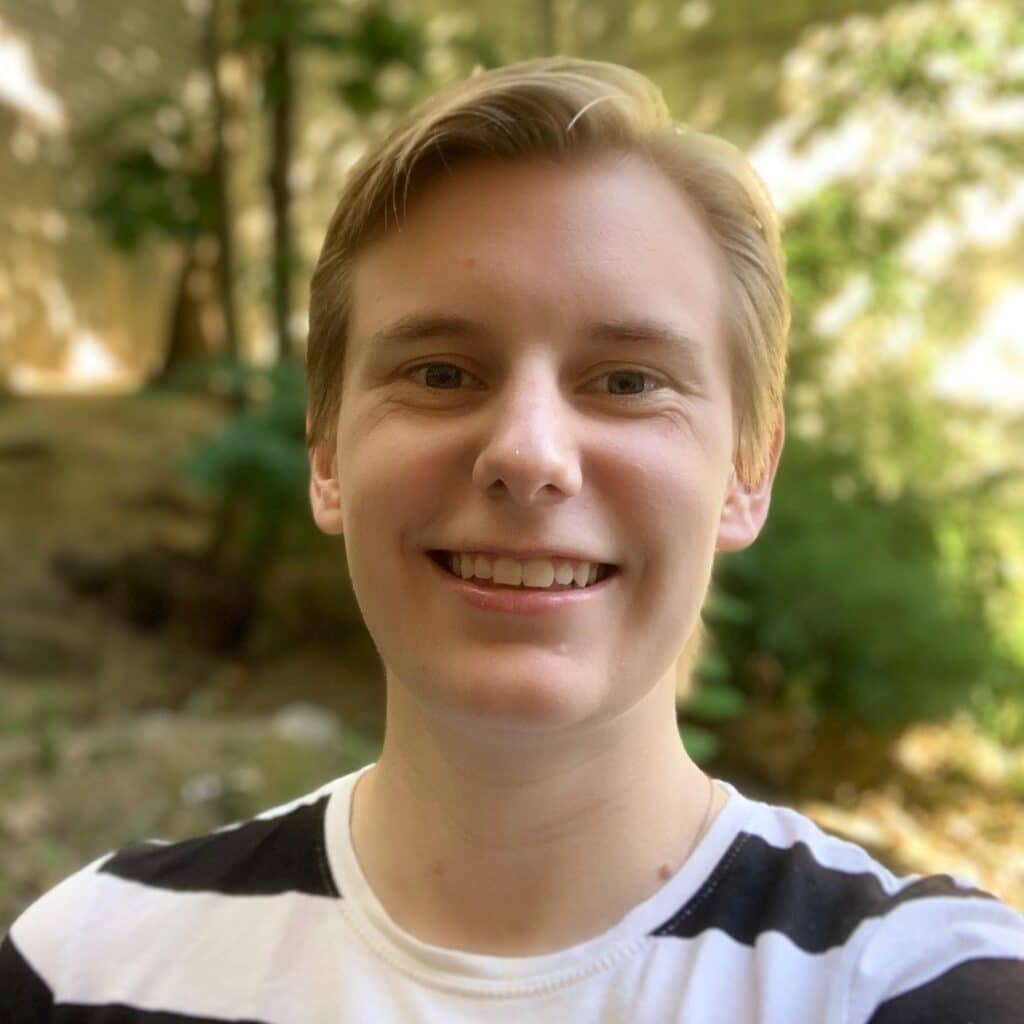
Professional background, what you study here at BC (and broader academic work), your role at CDIL, and anything else you’d like to share.
Sure! I’m Abby Tetzlaff. I’m part of the Learning Design (LD) Team as the Learning Design Graduate Assistant at CDIL. I’m a Ph.D. candidate in English here at BC, and I work particularly on 18th-century literature. My general focus on my dissertation is 18th century representations of London. I started my PhD program at BC four years ago, and I started at CDIL at the same time.
What drew you to being a part of CDIL’s team?
One of the reasons why I was really drawn to joining CDIL’s team is because I’ve always been interested in teaching, especially at the collegiate level. I was also really interested in how a course comes together: how learning design works, and how programs at BC create their courses for students to both fit the curriculum and also be engaging. I applied to CDIL because I knew a few people who worked here who were in my Ph.D. program. They described what the center does to me, and I found myself really drawn to it. I especially resonated with learning science and found myself interested in connecting with faculty and content experts. I think a lot of my motivation is that I hope my role here will make me a better teacher, being able to understand learning design from a more evidence-based framework.
What would be your favorite part of your work at CDIL?
There are two things that have become important to me throughout the years. One is the relationships with faculty and with other learning designers. I’ve gotten to know quite a few faculty from various different schools on campus that I would’ve never met otherwise. I’ve developed relationships because of the work we do together. We email, we get coffee, and I feel I have built a small community across the different schools on campus. I also enjoy the spontaneous creativity that sometimes happens in learning design meetings (and informally outside of these meetings). A faculty member may say something that sparks an idea in my mind that will help solve a problem, allow us to try a new learning technology, or present a new way of building a module to make it more interactive, and the possibility that those moments will happen in a meeting is exciting to me. In meetings with faculty and bouncing ideas off one another, sometimes something interesting and new can come out of it.
How would you describe broadly, in your own words, the work that CDIL does?
To me, the LD team helps faculty and programs at BC build interesting, effective, and innovative courses that students not only want to take but enjoy taking. I think sometimes the learning-online experience can be isolating; it can be dull; it can be unengaging, and I think one of the big jobs of CDIL is to make that not the case. We work to make courses engaging and, even at a distance, create community.
How has your understanding of the Center changed over the time you’ve worked here, and how have you grown with your experience at CDIL?
I would say it’s grown quite a bit. Since I started, I have a better sense of the scope of the Center, its goals, and its role on campus. Additionally, since artificial intelligence made its entrance on our working and academic lives, I have seen how all the teams at CDIL have worked to help faculty and students continue to teach and learn authentically in an age of advanced technology. For me, as I have learned more about learning technologies and learning sciences through CDIL, I have become more confident as a designer and, for my work with the English Department, as an in-person teacher. I have learned how to design an assignment that students will both understand how to complete and understand why it is important for their intellectual development. I have learned how to structure a lesson so students don’t feel like they’ve been overloaded with information at any point based on how we design the cadence of each week in a course. I served as the Associate Director of the First Year Writing Program at BC last year, and in that role I helped redesign a sequence of syllabi that could then be standardized across the program, so I used what I learned about program outcomes and backwards design strategies from CDIL to help our group in the English Department build syllabi that conformed to BC’s Core requirements.
Is there any unique way that your work intersects, academically and professionally, here at CDIL?
As I have been given more responsibilities to consult with faculty while working at CDIL, I actually see more of a relationship between my work as a first-year composition instructor and that side of my CDIL role. I find that I try to follow the tenets of peer review that I teach students in my writing course, and so far those tenets have served me well. When you’re doing peer review with another writer, and you’re giving feedback to someone, you want them to trust you. You want to show that you understand their experience as a writer (or in this case, their experience as a teacher) and quietly bring your own perspective with you into the conversation. One of the main jobs of a peer reviewer is to articulate the audience’s experience of a piece of work for the person who wrote or developed it, so the writer or developer understands how it might be received after it leaves their hands.
I work with faculty to help them present their material in a way that is both true to their own style and also understandable to others. It is through these conversations that I can advocate for the students’ experience, and I work with the knowledge that, at the end of the day, this is the faculty member’s course and they will ultimately be the one responsible for it. I want to have supportive conversations, bringing, hopefully, new ideas or interesting concepts to them that they hadn’t thought about, and help produce something together that neither of us could have developed alone.