In “Reimagining Faculty Development as Formation,” the CDIL Learning Experience Design team explores how faculty development can itself become a formative experience.
Introduction
Last year, we set out to reimagine how we could better support Boston College faculty who are new to online teaching. We began with the following question:
How might we design faculty professional development to better reflect BC’s commitment to formative education?
At CDIL, we believe the most meaningful learning experiences are rarely designed alone, and that the design process can be as formative as the courses themselves. This belief guided the redesign of our core faculty development course, with a new focus on designing online learning experiences for student formation. The redesigned four-week online course introduces faculty to the foundations of formative education and evidence-based approaches to online course design and teaching. To bring these concepts and ideas to life, we designed an experience that would allow faculty to not only learn about formative education, but also to experience it firsthand as learners. This means that we intentionally created learning opportunities in the course for faculty to align their identities, values, and professional goals with their pedagogical choices.
Bringing Attention, Reflection, and Action into Faculty Development
We structured the course around three key elements of Jesuit pedagogy: attention, reflection, and action.
1. Attention to the Whole Person
We began by seeing faculty as whole persons, beyond disciplinary expertise, including their lived experiences, teaching philosophies, hopes for students, and evolving professional identities. Meaningful faculty development created space for these dimensions rather than focusing exclusively on particular teaching skills or technologies. Throughout the course, we invited faculty to bring these often hidden aspects of themselves into the professional development experience.
One concrete way we brought attention to faculty’s whole selves into the course was by starting the professional development process with a Teaching Persona Activity. Each faculty member responded to a set of prompts that encouraged them to reflect on what they would like for their students to know and become by the end of the course, moments of teaching success and satisfaction, and previous or anticipated challenges to teaching online.
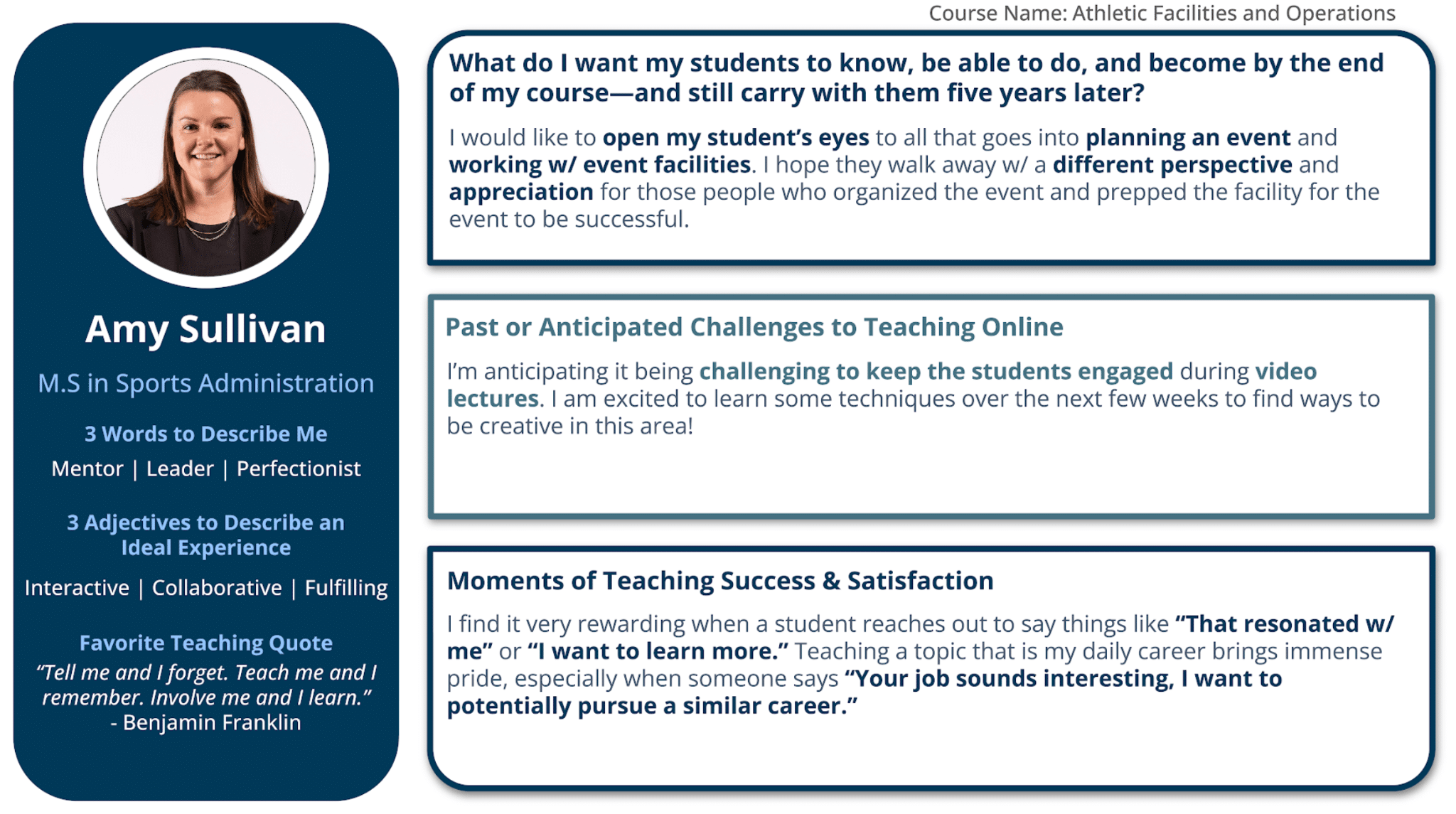
This activity expanded our understanding of faculty beyond their academic discipline, departmental home, or professional experiences. Each faculty member’s teaching persona helped us to see who they are now and who they hope to become as educators.
We saw these parts of the faculty experience as valuable assets in faculty formation, where new connections might form and new ideas might emerge. Throughout the course, faculty were invited to connect the formative education tradition with their own beliefs and practices through guided reflection exercises, such as the “See, Think, Me, We” exercise we discuss below. These checkpoints continually brought them back to thinking about their whole selves, what mattered to them, and what they wanted to take with them from this PD experience. In doing so, they formed new connections between who they were, what they were learning in the course, and the broader institutional values.
2. Reflection in Community
We believe that reflection happens richest when in community with other learners. We intentionally designed this course to make visible to our faculty participants the multi-layered communities they are part of at BC.
Faculty new to online teaching took a virtual tour of exemplary online course design, drawing ideas and inspiration from one another. As peers in the course, they engaged with each other, exchanged perspectives, and formed new ideas. By having faculty pay attention to and reflect on curated examples from the broader BC community, we prompted them to learn not only from those in the course, but also from the faculty community beyond this individual course.
In this way, we positioned reflection as not only a personal experience, but also a social one.
When we reviewed our end-of-course feedback survey, we found that, overwhelmingly, faculty found the examples from other colleagues as one of the most valuable parts of the course. Faculty said that they enjoyed the examples from other BC faculty, and they allowed them to brainstorm and use similar ideas in their own course, even if the examples were in another discipline.
One example of an activity we used to help faculty think about how they might adapt other BC faculty’s work for their own context was a modified version of Project Zero’s “See, Think, Me, We” reflection activity. Faculty first identified what stood out to them about formative education online (See), then connected it with their own current practice and values (Think), considered what they might do differently in their own teaching (Me), and finally reflected on what kind of shared effort the BC community could make together (We).
3. Action Through Design
Faculty were then encouraged to bring those new understandings into practice. Rather than leaving formative education and online course design as abstract concepts, they translated them into concrete design decisions for their own courses. This could be as specific as deciding what kind of assignment they would use in a particular module or how technology might better support student learning.
After forming new connections and ideas, faculty were encouraged to take the next step by engaging in design sprints. These low-stakes environments let them put ideas into practice, test them, and receive feedback from both the learning design team and their peers. This helped move faculty from what they hoped to achieve to how they might actually accomplish it in their own courses.
Take technology integration as one example. After reflecting on their course vision and exploring examples of technology use from the BC community, faculty completed an exploration of technology they might integrate into their course. They identified one specific week or module where a technology could meaningfully support learning and considered a potential implementation challenge. Faculty particularly appreciated this module, especially the examples demonstrating how AI could support cognitive engagement.
Faculty mentioned that the design sprints put them in an assignment-revision mindset, and that the technology tool design sprint was the most valuable as they consider online course design. One example was using VoiceThread as a concrete solution for delivering presentations in a fully asynchronous course. Faculty reported leaving with concrete design changes, not just an idea.
Faculty Formation as an Ongoing and Collaborative Process
Over the course’s four weeks, faculty experienced multiple cycles of attention, reflection, and action. Rather than a linear sequence, these elements continually reinforced one another. Faculty were constantly invited to return to their values and beliefs, form new connections, and keep refining their action plans as they continued working with their learning designers beyond this professional development course. In this way, the cycle of formation continued.
For us, learning design is a fundamentally collaborative process grounded in shared curiosity, reflection, and purpose. In addition to the pedagogical and design expertise we bring, we also see ourselves as companions in faculty’s professional development journey by asking questions, listening attentively, surfacing ideas, exploring possibilities, and facilitating reflections. And we do all of these with faculty, not for them. We believe meaningful change happens when faculty are empowered to create online learning experiences that authentically express who they are as educators while finding meaningful connections between their commitments and the institutional mission. This is how we live Boston College’s mission in the daily practice of learning design.