How can we move beyond the textbook to help all types of student learners master difficult course content? I spoke with Holly Deak, Professor of the Practice, and Marc Snapper, Professor of Chemistry, who developed over 700 bespoke exercise problems for Organic Chemistry I and II to help foster deeper student learning.
Project Overview
Tell me a little bit about your project. What were some of your initial goals? What were you seeing in the field or department that inspired you to undertake a project of this sort?
I first began a project to develop three exercises with the Digital Design Working Group in 2022-2023, but then applied for an Academic Technology Innovation Grant (ATIG) to expand upon it.
Students need to be able to “read” the structure of a molecule to do almost anything in Organic Chemistry. This is essential to O-Chem, and students were coming in unprepared to “read” structures as they needed to for the course. Molecules in O-Chem are depicted using a visual notation that represents the structural elements of the molecule, such as its functional or reactive groups. Students must learn to read structures using this notation, as it is how they can determine a molecule’s behavior and how it may react with other molecules.
Through the ATIG, we have created approximately 40 exercises with about 700 problems customized to the course content in Organic Chemistry I and II. It is available to all students taking the Organic Chemistry course sequence and has recently been shared with the Honors Chemistry program.
First, I had to determine where it would be most useful for students to start in problem solving. In my experience, if I asked students which functional groups are present in a molecule, they would suddenly understand which direction to go and how to answer the question. So for our initial efforts we thought, “Okay, let’s help students learn to identify functional groups.”
We began with these flashcard-style molecules that had one reactive group in them, one functional group. Students could say, “Oh, okay, that’s an…” and we had some structural diversity here that was not well-represented in existing content.
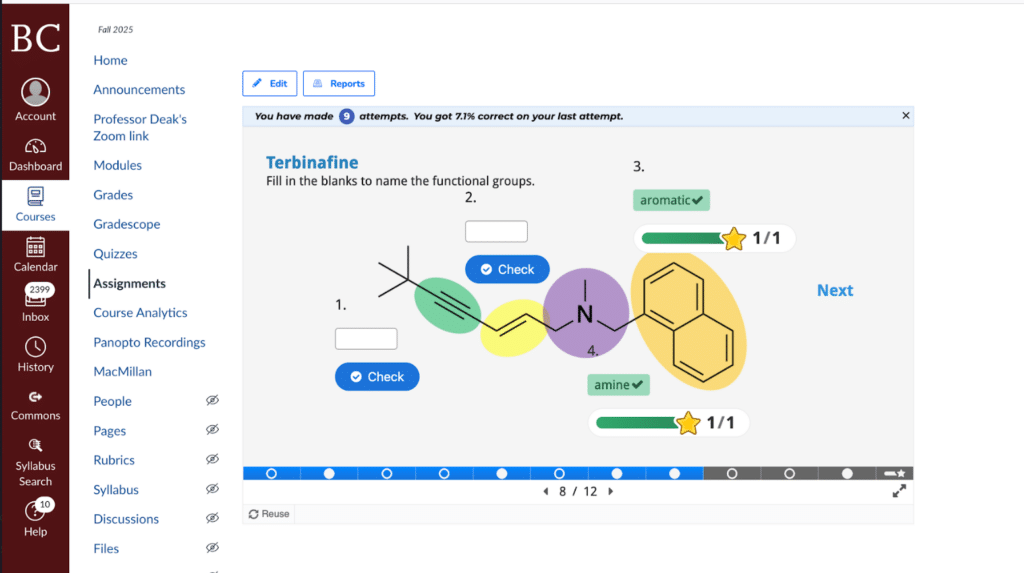
From here, we moved on to exercise two, Marc’s idea: a drag-and-drop activity. For example, one question displays the structure of aspirin, and students could say, “Oh, okay, I recognize that as an aromatic ring. I can drag that over here. This is a carboxylic acid.” They could test themselves and check their answers.
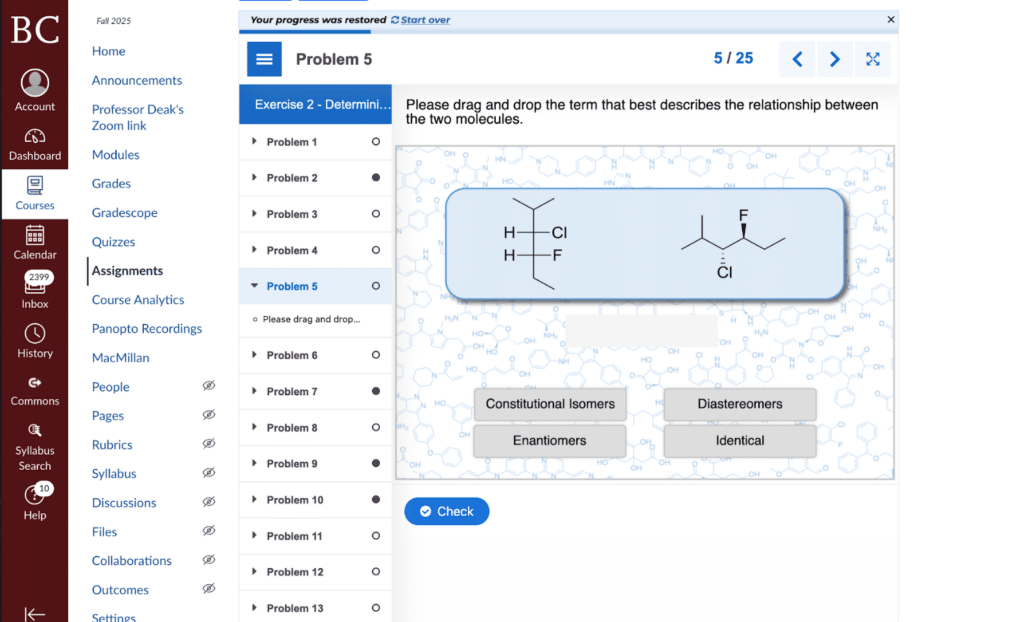
We gave them practice with actual molecules they may have learned about—acetaminophen, vitamin E, different drug molecules, fragrance molecules, vitamins—things they might encounter in real life or in other chemistry courses. Then the last and most difficult exercise in this series required them to type in the name. They had to recognize it, remember the name, and type it in.
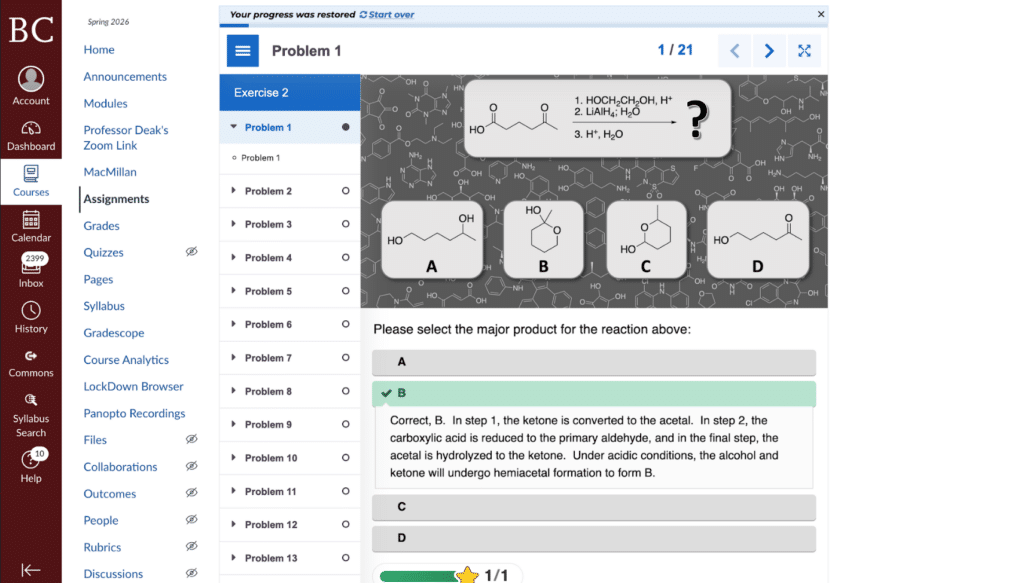
We also developed many “predict the product” exercises, a very common type of problem in Organic Chemistry I and II. Students examine a molecule, identify its functional groups, and assess it. Then they say, “Okay, what will happen under these conditions in step one? And then what will happen under these conditions in step two?” They come up with a product and check their answer.
Development Process
You said you now have over 700 questions, which is a huge amount of work in H5P. As an instructor, what was the process for developing and building this and adding it to the course? Did you encounter any problems, and if so, how did you solve them?
(H5P is a tool used for creating interactive content for students that you can then integrate into your Canvas site.)
One of H5P’s limitations we encountered was that when creating solutions in H5P, you can’t incorporate images. While that at first seemed like an obstacle, it ultimately strengthened students’ learning. Rather than images, all of these reactions had to be described in words. It provided some benefit because it allowed students to read the solution and work through it on paper, drawing out what was happening at each stage of the reaction sequence.
The answer wasn’t simply given to them—they still had to work on it, which made it useful. Ideally, we would like images of the structures in the solutions, but that isn’t a capability right now. However, having to spell out the reaction allows them to break it down into pieces and match it up to the visuals, another valuable skill.
Impact on Student Experience
Can you tell me a bit about how this has changed the experience for students in the courses?
Marc:
I think we offer students a number of different ways to learn the material. Typically, there are the lectures, there’s the book, and there’s problem solving. These exercises just complement that. Different students have different ways of learning, and this fits right in and reinforces the material. Many of them appreciate this alternate way of reviewing and learning the material to really reach all types of learners.
Holly:
We surveyed students and had over 50 responses. That’s not huge compared to the size of the class, but the results were strongly positive. Students felt it helped them navigate course content, perform on assessments, and feel more confident. The data was compelling, especially the data on student performance before and after we implemented the exercises. There was a type of problem where, in 2023, 61% of students got the question right. After implementing the app exercise for that chapter, 90% of students answered it correctly. Just having another way to practice made a difference.
We also got positive feedback about the game-like quality of it. Organic chemistry is very visual. The H5P platform was very amenable to representing structures in this way and gave us a chance to be creative with backgrounds and things like that. While H5P does not allow images in solutions, you can creatively customize the content on question slides. I think it’s visually appealing, and that reflects some of the feedback we’ve gotten.
Is there anything else you’d like to mention?
We had two undergraduates working on this over the summer, and one continued during the school year. Involving them was really critical.
One of the students, Mary Pangburn, said the following about her work on the project:
“I really enjoyed working on the app that helped me a lot when I took organic chemistry. It was great to be creative and to think of new, approachable ways to practice this really complex material. I am always excited to hear feedback from students and how it has also helped them!”
The second student, now-graduated Jackson Yates (‘25), was a biochemistry major who had been conducting research in the chemistry department for a long time. He came up with problems for one module because he thought it was a particularly hard topic and wanted students to get more practice. He had ideas about sticking points and how to address them through different problems. On the experience, Jackson said:
“I really loved my organic chemistry class as an undergrad, so I was very excited that Professor Deak allowed me to help with the H5P app. While creating problems on the app, I often thought about topics I personally found challenging, like learning stereochemistry for the first time, and tried to design practice questions that would have helped me when I was studying. I think the H5P app is such a valuable resource because it gives students extra practice with difficult concepts and builds confidence before exams.”
It was nice to involve students who had taken the course and had opinions about how student learning could be improved. It meant we were able to truly incorporate the student perspectives into the project.
Advice for Other Faculty
What advice would you give to another faculty member interested in a project like this?
I had a vision for this from the beginning, but I needed an idea of how to actually build it out. When I was in the learning group, John Fitzgibbon connected me with H5P because it was the best option for this kind of visual content.
When I went to the H5P website, I saw it used in many different ways, some of which were very well suited to our content. One important part of the process was having a vision of what I wanted it to be, and then matching the tool to that vision.
My advice would be to share your vision and engage with others to make it happen. I’m hoping someone sees this article and reaches out. I’d be happy to help.