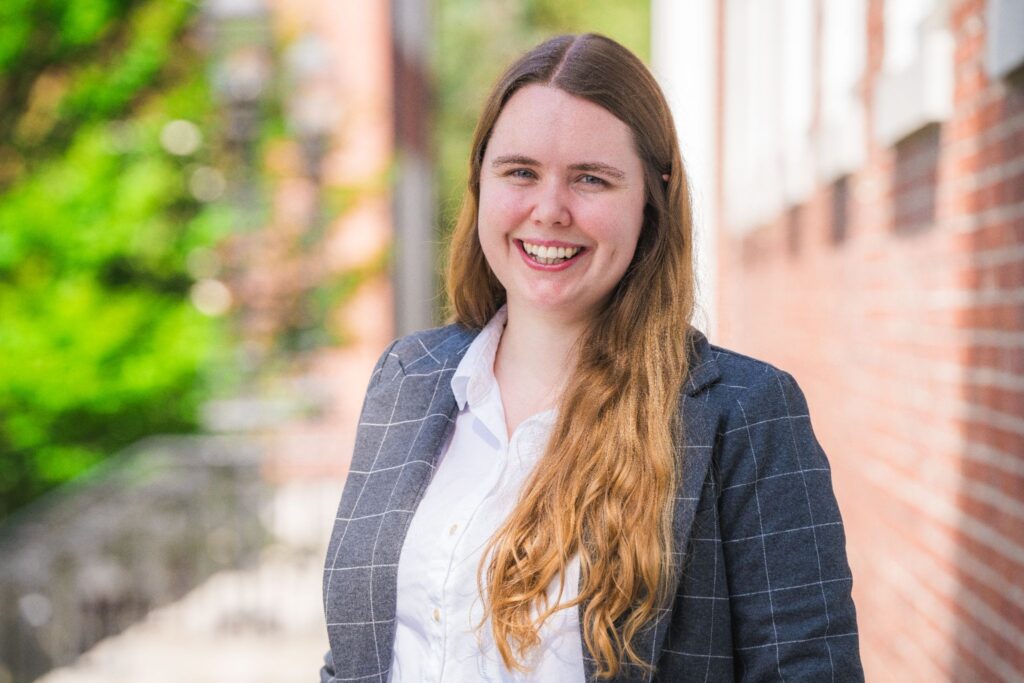
Zoe Pell, Senior Learning Experience Designer, and Abigail Tetzlaff, Learning Design Graduate Assistant, spoke with Data Science Program Director Dr. Emma Klugman about how she partnered with CDIL to develop a Capstone course that sets students up for fruitful careers.
“At the beginning of any project, I think people have a lot of goals and a lot of ambitions. And then you usually have to give up on some of those due to practical constraints or time constraints,” says Dr. Emma Klugman, Assistant Professor of the Practice and Director of Boston College’s Master’s in Human-Centered Data Science. The program launched in 2024, and Dr. Klugman recently developed the last course of the Master’s, a two-semester Capstone course, in collaboration with CDIL.
Despite the general sentiment that one must always let go of a few hopes and dreams in order to get a project across the finish line, Dr. Klugman feels that the program’s Capstone course was an exception. “One thing I have just been so pleased with is that the Capstone really does capture pretty much everything I had originally hoped for, and I think even more than I hoped for.” But why was this large project so important, and how would it benefit students?
The Bigger Picture
The Capstone is the final installment in a series of ambitious course development projects that make up the program’s two-year, part-time, fully online offerings. Whether students enter the program to advance their knowledge in data science or take the first step in a career shift, courses build from foundational to cutting-edge. What sets Boston College’s program apart from many other data science graduate degrees is its ethical, human-centered approach to data science. Each course pairs rigorous technical training with discussions, hands-on assignments, and case studies that prepare students to apply their data skills in service of the greater good. Dr. Klugman speaks highly of students in the program’s inaugural cohorts: “Our students have fields in mind that they’re really passionate about. For example, some really care about going into healthcare and making that more fair and equitable using data science skills. Their passions make our class discussions really rich because we grapple with the ethical questions surrounding data in these fields along the way.”
The program’s values find a comfortable home at Boston College, where other human-centered programs have emerged in recent years. Dr. Klugman also found it useful to incorporate a version of the reflective Jesuit practice called examen as a way for students to think deeply about their work, their intellectual growth, and their identities as ethical data scientists.
To harness students’ interests in using data science to engage positively with the world, Dr. Klugman wanted to braid together three key pieces in the program’s capstone course. She desired to expand students’ data science toolkits with advanced, practice-driven skills that go beyond the textbook, guide students in building a high-impact project they can showcase to future employers, and encourage them to define their own paths as professionals in their chosen field. “We’re really trying to respect their maturity and professionalism as emerging data scientists with this course,” says Dr. Klugman. The learning experiences and activities associated with each of these goals, however, deserve individual courses of their own. The challenge lay in getting all the pieces to work together.
Designing for Success
To meet this challenge, Klugman worked closely with CDIL to design the Capstone with two distinct features: structured support and scaffolding for the months-long, hands-on projects where students work with real stakeholders on real problems, and a series of professionalization modules that help students learn advanced topics and get them ready to navigate the job market with confidence.
Rather than break up the project and the professionalization modules into separate semesters, the course was designed for students to alternate between these two interwoven paths, allowing each to inform the other in a steady rhythm throughout the year. As such, “Applied Project” weeks deal with the long-term project they work on with clients spanning Boston College researchers, non-profits, start-ups, and other organizations. These sections of the course consist of routine check-in meetings, stakeholder updates, timeline proposals, progress reports, and other deliverables. “Professional Seminar” weeks offer more traditional learning experiences that deepen students’ skills, introduce new techniques, and apply them in focused, smaller-scale projects. “Professional Seminar” weeks ask students to compose resumes, portfolio websites, and practice technical and behavioral interviewing to support their career development.
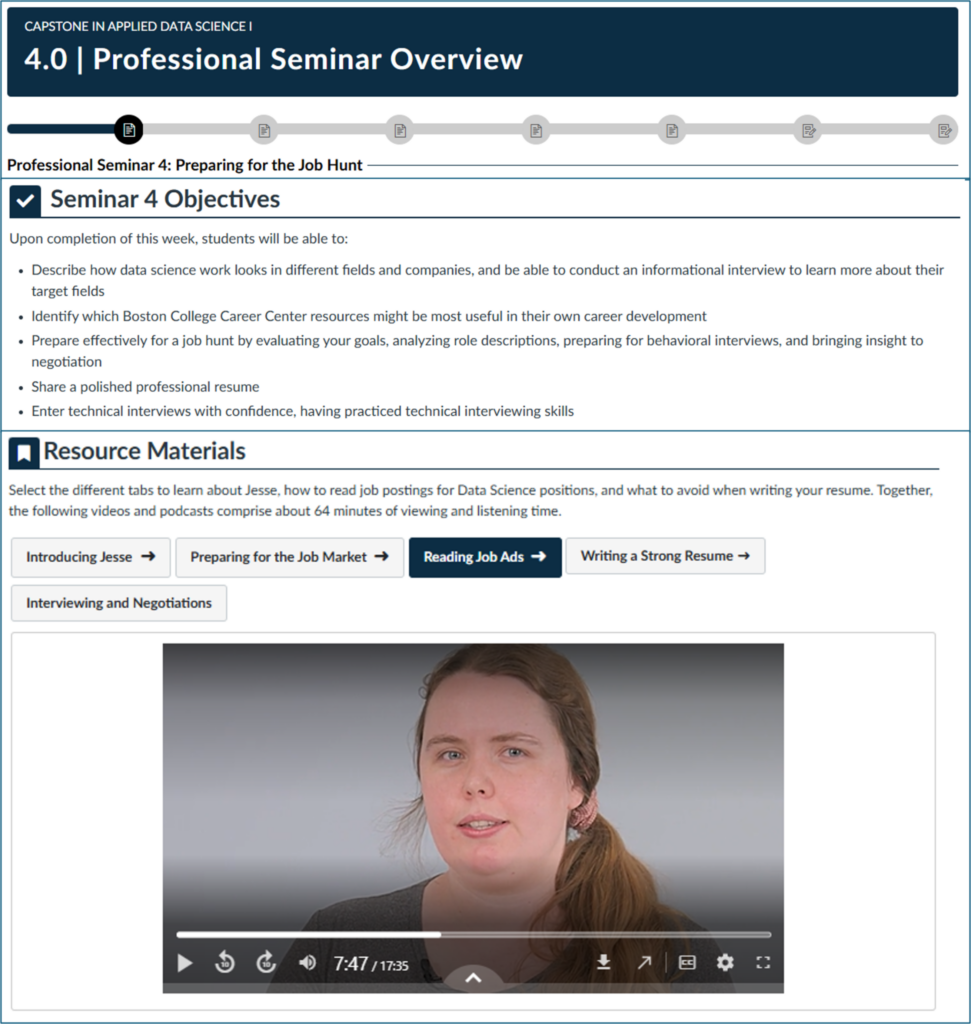
Given the course’s incredible variety of topics and tasks, from absorbing information about the field, navigating large datasets with advanced concepts, practicing writing and speaking skills, and engaging complex topics required to navigate the course, Dr. Klugman and the CDIL team’s Canvas design focused on turning complexity into consistency and clarity. The team devised a system of visual and structural supports to help students move through the alternating weeks of their 24-week Capstone. Every icon, page, and image had a purpose: to keep information organized and to encourage students’ progression through the week without overwhelming them with text.
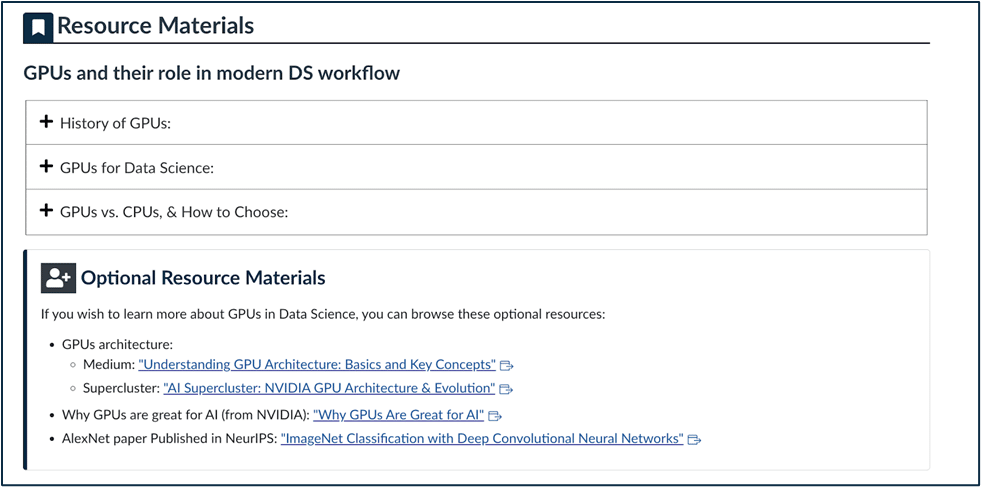
The course even delineates between information students are required to engage with versus resources that are there for students who want more: “We commonly used a little box at the end of a page for ‘optional resource materials’ to give students the option to dive deeper if they want to, or to bookmark things for later that they can return to,” remarksed Dr. Klugman. “We give them that offer of curated materials, and then respect their choice for how to engage.”
Information-dense weeks also utilize video and audio elements alongside text to keep any sense of information overload at bay. One of the standout features of the course is a series of interview videos that capture a variety of career trajectories and professional stories. Drawing from her own professional network, Dr. Klugman interviewed twelve data scientists from a broad range of fields and career levels and asked them each the same set of questions: their journey to data science, to describe one project that inspired them, how they landed their job, what their typical week looks like, who their company tends to hire, and what they wished they had learned sooner.
“Hopefully students will see themselves in these diverse responses and realize, for example that ‘oh, I’m not the only one for whom the first job wasn’t the right fit, and then pivoted and found success afterward,’,” remarksed Dr. Klugman. “I think these videos will inspire students and hopefully help them feel a real sense of belonging. They get to experience a distillation of the wisdom of the whole data science community rather than just a few coffee chats on their own.”
Success Through Partnership
So far, it seems that students appreciate how clearly the course is laid out. “I’ve had shockingly few questions about logistics, and shockingly few student questions about how things look, or the week-to-week, which is so nice,” reportsed Dr. Klugman. “Doing a lot of this design thinking and design work up front, and having other people’s eyes on it to see if it makes sense to them has meant that, now that the course is running, the focus as the instructor can be around making live sessions really rich, and providing really great feedback rather than the nitty-gritty of explaining the course structure.”
When comparing the typical in-person design process to designing a course with CDIL, Klugman emphasizesd the generative nature of the collaboration. “I think teaching and designing courses for the physical classroom has often been a pretty solo experience,” she notesd. Designing an online course with CDIL requires, in Dr. Klugman’s own words, a “mindset shift.” “You begin to think about course design as a collaboration. In that collaboration, our data science faculty are able to work with an online learning expert and incorporate best practices and design ideas that improve what the finished course looks like. Working with someone else who really cares about the course you are working on means that you can produce something really beautiful together.”