
How Associate Professor Joshua Seim (Sociology, MCAS) prompted students to build connective tissue between his course’s content and their future careers
Over Summer 2025, the Career Center (CC) — in collaboration with the Center for Digital Innovation in Learning (CDIL) and the University Council on Teaching (UCT) — launched the Integrative Learning Faculty Grant, a new initiative designed to recognize and support faculty members who are interested in fostering integrative learning in their classrooms.
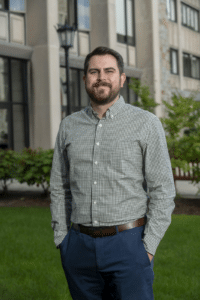
Why did you apply for this grant?
I applied for the Integrative Learning Grant to more intentionally connect sociological analysis to students’ lived experiences and emerging sense of purpose. While Sociology of Health and Illness already asks students to think critically about inequality, health, and medicine, I wanted to move beyond a single end-of-semester reflection and instead scaffold integrative thinking throughout the course.
What were you hoping to gain from your collaboration with CDIL and the CC?
I was hoping to redesign the reflection exercises in my course and was especially interested in concrete ideas for scaffolding a stronger final assignment. In particular, I wanted students to extend course theories beyond the classroom and into their past and anticipated personal experiences. Collaboration with CDIL and the Career Center helped me think more deliberately about how reflection could build toward a meaningful culminating experience.
What surprised you as part of this collaboration?
I was surprised by how quickly the collaboration reshaped my thinking. After the very first meeting with CDIL and the Career Center, I walked away with an entirely new assessment idea: a sequence of reflection assignments designed to prepare students for an end-of-semester conversation with a relative stranger about their future. I had not previously imagined using tools like EagleExchange in a sociology course, but the idea immediately clicked as a way to support a more ambitious final project.
What’s your biggest takeaway from this collaboration?
My biggest takeaway is that the Career Center is a valuable pedagogical resource for faculty, not just a place to refer students. The Career Center staff helped me think through course design and learning goals, while CDIL helped me envision how these ideas could be implemented online. Rather than offering a cookie-cutter model, the collaboration emphasized customization through conversation, which made the final design much stronger.
How will you continue to develop your project moving forward?
Moving forward, I plan to fine-tune the reflection sequence and culminating conversation assignment in future iterations of Sociology of Health and Illness. I also hope to adapt this model for other courses I teach, where students are similarly grappling with questions of purpose in an unequal world. Continued collaboration with CDIL and the Career Center will be especially helpful as I think about how to assess and refine these integrative assignments over time.
