
CDIL chats with Brenda Noriega-Flores, PhD, program director of the M.A. in Ministerial Leadership at the Clough School of Theology and Ministry, about developing this groundbreaking new program in collaboration with CDIL.
Can you introduce CSTM’s new M.A. in Ministerial Leadership? What makes this program unique?
The M.A. in Ministerial Leadership (MAML) at the Clough School of Theology and Ministry (CSTM) is a new graduate degree that aims to develop executive leaders for faith-based nonprofit and ministerial organizations. This degree has been developed as part of the Nuevo Momento: Leadership and Capacity Building for Ministerial Organizations Serving Hispanic Catholics initiative directed by Dr. Hosffman Ospino. One of the program’s distinctive strengths is that it is housed within the School of Theology and Ministry and is shaped by practical theologians and religious educators in collaboration with scholars from various schools within Boston College, experts from universities such as MIT, Villanova University, Catholic University of America, and Indiana University, among others, and nationally-recognized executive-level leaders working in Catholic ministerial organizations. As a result, theological and spiritual formation is integrated throughout the curriculum rather than included as an afterthought. Our focus is not only on theological foundations, but also on the pedagogy of formation: how leaders learn, discern, and develop practical judgment for complex organizational realities.
Can you talk more about these pedagogical signatures? What are the unique opportunities this program offers?
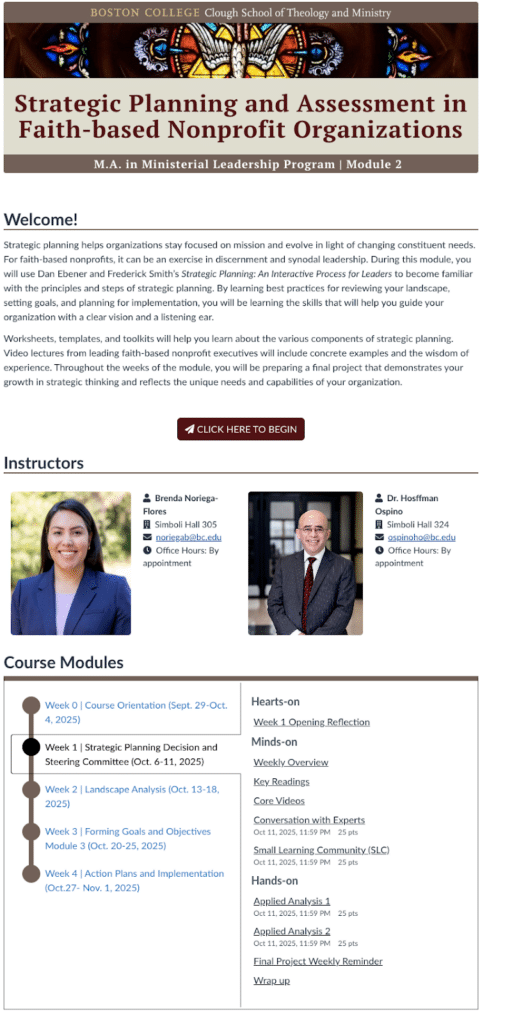
The program is organized around a formative framework we developed: Hearts On, Minds On, Hands On.
Hearts On:
Throughout the program, students engage in reflective and prayerful practices that keep executive leadership rooted in Christian moral and spiritual commitments. We return to foundational questions: What does it mean when we speak of human dignity? What does human dignity look like in the workplace, especially at the executive level, such as compensation, policies, culture, accountability, and care? When we speak of faith-based executive leadership, what informs their executive decisions and their relationships with different stakeholders? How do leaders translate faith values into concrete practices that affect real people and real communities?
Minds On:
Minds On focuses on critical engagement with core frameworks, drawing from theology, organizational leadership, and evidence-based practice. This work comes to life through readings, conversations with experts, mentorship, and peer learning.
Mentorship is one of our pedagogical signatures in the program, intended to help transfer skills needed for leadership. Therefore, the students are paired with a seasoned executive leader who will walk with them for the entirety of the program as they grow in practical wisdom, leadership habits, and professional discernment.
In addition to mentorship, another one of our pedagogical signatures is small learning communities. The small learning communities use the listening circle method, which helps the students practice disciplined listening, perspective-taking, and discernment: learning when to speak, when to ask better questions, and when to create reflective space before responding. Participants are encouraged to sometimes not say anything, but to really take it into prayer and discernment which would hopefully turn into transformation. Over time, these communities also become a durable network of mutual support as students continue into broader executive responsibility.
Hands On:
Another one of our pedagogical signatures is our case studies. In the context of graduate-level education, case studies are a strategic pedagogical tool used to bridge theory and practice. Rather than learning leadership, management, or theology in the abstract, students are presented with real-world scenarios, complex situations from ministry or faith-based nonprofit contexts that require discernment, leadership decisions, and ethical reflection. Students complete two steps for case studies. First, they have to analyze an existing published case study. Then the second piece is to develop a case study on their own. Every week, they look at a different area of their sponsoring organization (mission and vision, strategic plan, governance and leadership, etc.) They assess their organization based on the course materials and using the “N.E.W. Assessment” framework we developed in Nuevo Momento, and they provide recommendations. Everything the students recommend can be applicable to the organization they are working with.
Unlike conventional nonprofit evaluation tools, which often rely heavily on quantitative metrics, logic models, and market-oriented indicators, the N.E.W. Model of Organizational Vitality Analysis offers a pastoral, mission-centered, growth with purpose, and spiritually grounded approach to assessment. Developed by Nuevo Momento, an initiative deeply committed to the growth and success of Catholic ministerial organizations serving Hispanic Catholics, the N.E.W. model reflects a theological understanding that organizational vitality is inseparable from mission fidelity and spiritual renewal. Rooted in the Catholic Standards for Excellence and pastoral theological reflection, this model allows organizations to identify what is Noteworthy, what is Evolving, and what Welcomes Support, offering a more holistic view of organizational health. Nuevo Momento believes that a culture of assessment is essential not only for operational growth but as a sign of trust in the renewing work of the Holy Spirit.
What else would you like people to know about this program?
One distinctive feature of the MAML is its formative assessment model. Courses use clear performance standards and robust feedback within a pass/fail structure. This helps students focus less on point-scoring and more on growth in judgment, ethical decision-making, and executive leadership capacity—because, ultimately, leadership formation is measured in how leaders navigate complex decisions and relationships with stakeholders in mission-driven environments.
How did working with CDIL impact the development of this program?
Our program is centered on collaboration and growth, which is also reflected in CDIL’s community-based learning design. Working with CDIL gave us a structured design pathway and helped us feel part of a village in the work of forming leaders. The learning designers at CDIL brought their gifts, and I brought mine. I knew this team was here to support me. The course design process allowed me to be really explicit about what I’m looking for from students, moving from implicit to explicit knowledge to support student learning.
As program director and lead curriculum designer, I’ve been grateful for the contributions of our research assistants, Margaret Felice (Ph.D. student in Theology and Education) and Natalia Dilan (M.A. student in Theology) at CSTM, whose research synthesis, drafting support, and quality review have strengthened the coherence and clarity of the student experience.
If I had to sum up CDIL’s impact on the MAML program in a few words, I would call it a safe space of collaboration in the journey of education. Our program is all about the journey of learning and growth, and it was wonderful to work with a team that reflects these ideals in their own process.
