A common challenge when moving a course online isn’t the material itself, but how it’s presented to students. Instructions that are clear in the classroom can become harder to follow once they’re posted on Canvas. What might be explained quickly in class often needs to be planned and organized in advance.
After observing these trends, learning experience designer Kyle Carr sought to integrate accessibility more deeply into the design process to improve the student experience. The outcomes and changes are discussed below.
Designing for Experience

During faculty development meetings, I noticed several recurring needs during the course design process. Assignments that seemed clear in conversation sometimes became more difficult to follow once they were built in Canvas. Instructions were occasionally spread across multiple locations or embedded in longer pages. Students then had to find key information before they could even start their work. When a course moves online, these teaching elements all need to be taken into consideration and integrated into the course design. What we ask students to do remains the same; they continue to read closely, analyze ideas, and develop arguments. The only thing that changes is how students experience those expectations.
Accessibility often entered these conversations as well. It has long been part of our institutional and Center commitments, though it does not always shape early design decisions. Compliance is the floor, not the ceiling. Course designs may meet the minimum requirement, but we should do more to provide access and equity for our students. When questions about document structure, captioning, or course site navigation are raised during initial planning, courses tend to develop differently. This means we prevent having to go back and revise materials that are already in place.
Structure as Care
At Boston College, the concept of cura personalis, or care for the whole person, guides much of our work. In digital learning environments, that care is reflected in how a course is structured so students can access materials and engage in class activities.
My training in sociology often shapes how I approach these questions, especially in thinking about how course structures influence access and how small design decisions can affect who can participate fully. Structural decisions influence participation and accessibility in ways that are not always immediately visible. For example, a consistent weekly structure helps students anticipate what to expect as the semester unfolds. The way a document is formatted can determine whether it is usable for students who rely on screen readers.
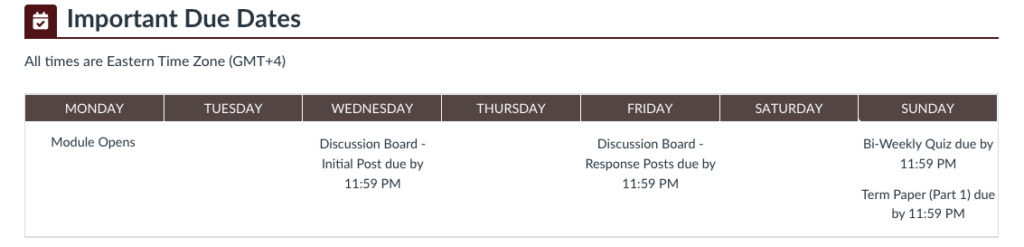
A screenshot from the author’s online class that demonstrates the weekly structure for his course.
These choices help create a more inclusive environment without changing the course’s core learning outcomes. Incorporating accessibility provides an opportunity to improve the learning experience for all our students, rather than treating it as something to address only after a barrier appears.
We want to shift from being reactive to proactive in our course design work with faculty. When accessibility is addressed only after a course has been built, the process becomes reactive. Videos are captioned after they have already been assigned. Documents are reformatted after barriers are identified. Navigation is adjusted after students encounter difficulties. When accessibility informs early planning, these elements are already integrated. Students can then focus on the course itself rather than on whether they can access it.
Over time, these patterns became more visible across our development work, such as how often accessibility was addressed after a course had already been built. This led to a question for us at CDIL: At what point does accessibility enter the development process, and how might it appear earlier, shaping design decisions?
The Inclusive Excellence and Accessibility (IE&A) Working Group
The IE&A Working Group emerged from this question. Rather than approaching accessibility as something addressed near the end of development, we aimed to understand how it moves through the process and where earlier conversations might influence course design.
At Boston College, inclusive excellence means that the strength of a community depends on how well it includes the experiences of all its members. Students, faculty, and staff all contribute to creating that type of environment. In digital learning spaces, accessibility is one way that commitment to inclusion becomes real in practice. When students can navigate materials, participate in discussions, and access content without barriers, they are better able to engage with the coursework.
Course development at CDIL is collaborative. Different teams contribute at different stages, and those stages shape what students ultimately encounter. When we examined this process together, we found that accessibility was present throughout, but it did not consistently appear early enough to influence foundational decisions.
One outcome of this work came from our Learning Technology team. Andrew Petracca, Learning Technologies Administrator, developed a resource that outlines the accessibility strengths and limitations of Boston College’s approved Canvas-integrated learning technologies. The document helps us understand how these tools function across different use cases, including for students using screen readers, keyboard navigation, and captioning.
The working group has also reviewed development documentation and consultation practices to ensure accessibility questions are addressed earlier in the development process. These updates are gradual but influence how courses evolve over time. Equally important, this effort helps create a culture of inclusion and belonging and strengthens meaningful relationships with faculty throughout the development process.
Partnership in Practice
For faculty, this improved approach often shifts the focus of early development meetings. We consider how students will progress through the course independently, where instructions will appear, how expectations will be communicated, and whether the tools used support full participation.
Our goal is not to prescribe a single approach. Faculty bring disciplinary expertise and established expectations to their teaching. As a digital learning center, we offer a perspective shaped by how course structure and technology influence the student experience online.
As digital learning continues to grow at Boston College, how courses are designed becomes increasingly important. When accessibility is incorporated into the design from the start, students can focus on engaging with ideas and building arguments rather than trying to understand the course structure.
The IE&A Working Group represents one part of a broader effort at CDIL to ensure that accessible design becomes a consistent part of how digital courses are planned and developed.