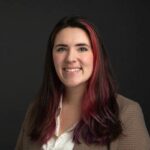
How do we equip students to have difficult conversations amid political polarization? Dr. Candace King, part-time faculty in the Woods College, developed an innovative seminar series, “Violence in America,” in which she both models these communication skills and provides students with the opportunity to develop them on their own. I had a conversation with her, which has been condensed and lightly edited.
Can you explain what your course is?
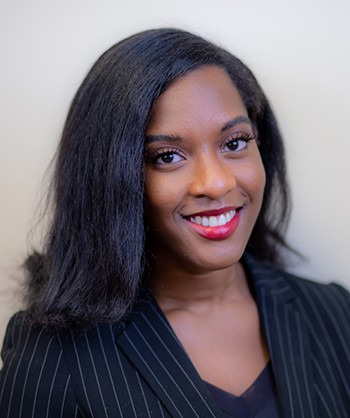
This course, “Race, Gender, and Violence,” is really, really special to me. It’s actually one of the very first courses I taught at Boston College, back in 2020. The course essentially tries to understand what the racial and gendered implications are of scenes of violence, whether it’s medical violence, police violence, sexual violence, etc. We deal with many heavy, complicated themes. And that’s one of the reasons I came up with my project, the seminar series: “Violence in America.” I wanted to approach this question of violence through a conversational lens. When teaching courses that are layered and very sensitive, I don’t want students to shy away from the discussions; I want them to talk about them confidently and without fear.
I think the only way we’re going to make progress is by showing up authentically as ourselves and not being intimidated by certain conversations. So I see this course as a primer, if you will, for our current cultural moment, where everything seems really politicized, and some would dare even say polarized. We are inundated with these issues every day, so I want students to have the tools to critically engage in these conversations, regardless of which aisle they find themselves in. This course explores these moments in history to help inform how they see the world today. I think that’s crucial, especially in an era of AI and misinformation.
What was your goal in creating this seminar series?
I saw an opportunity to share with students how I engage with these concepts in real time through dialogue with other scholars and people I interviewed, such as filmmakers and activists. Many of my students don’t come from traditional sociology backgrounds; they come from other academic disciplines, so I thought it was really important for them to see how these concepts apply across disciplines.
Another reason I did this series was to give them tools they could carry with them throughout their lives. So a connecting portion of the course involves students participating in a roundtable discussion. I randomly assort them into groups of three or four and give them a topic or theme. Each of them speaks for two to three minutes on a topic centered on race, gender, and violence. The goal is for them to model and apply tools and frameworks from throughout the course.
The purpose of the roundtable is to show that just because you’re taking a class online doesn’t mean you don’t have a network or classmates. A discussion board post is essentially just typing a comment on social media- and I thought students needed more engagement than that. The roundtable discussion requires students to meet and collaborate with one another, skills they would need to develop in an in-person course. It also provides an opportunity to flex and develop their presentation skills, which they can use throughout their lives and across disciplines. Students can be great writers, but if they can’t articulate their thoughts, that might give them a slight disadvantage in the real world.
How did you land on the idea of a seminar series? How does it change the way students learn and engage with the course?
First, I want to give a special shout-out and thank you to Woods College Dean Michelle Elias Bloomer, Associate Dean of Undergraduate Programs at the Woods College of Advancing Studies, and to Samuel Hay, who, at the time I developed this series, was the Associate Director for Undergraduate Programs. Both of them have been incredibly supportive, and I have to say this seminar series would not be the same without their trust and belief in me. I also want to recognize and thank Alexia Prichard, Senior Instructional Media Producer at CDIL. She is incredible. I brought this idea to her, and she helped me build the structure that made it possible.
To explain how I landed on this idea, I have to go back in time, because before I entered academia, I was a journalist. I worked at NBC News and MSNBC, which thrust me into the world of broadcast news. And so, when I did pivot to academia, I always wanted to know what it would be like to merge the two industries through storytelling and journalism.
I had taught online courses in the past, where I recorded lectures and used these really intense PowerPoints. But when I was grading students’ papers, I saw that they were just kind of copying and pasting from the PowerPoints. I wanted students to engage more deeply with this course. So I thought, how can I bridge the academic world with the media world? I’ve always found that students really enjoy guest speakers. I thought, well, what if I could create that experience every week and see what impact it has, if students could gain a deeper understanding of the work of the scholars and other speakers we were focusing on in the course material. That’s how I came up with the “Violence in America” series.
What advice would you give to other faculty hoping to form new modes of engagement, or faculty hoping to leverage their own backgrounds in their teaching?
Number one is to understand the type of students that we have. Boston College students are among the most ambitious, curious, and intellectually astute students we have. So it is really important to challenge them.
Number two is to really take advantage of the amazing resources that BC has. There are so many resources available- I took advantage of retreats with amazing folks planned by people like Stacy Grooters at the CTE, and I worked with the CDIL team. There are so many brilliant people at Boston College who are incredibly supportive and available to help us. Even if you don’t know where to start, don’t be intimidated. Just reach out!
If you’re interested in leveraging your background, think about what can be applied in an academic setting. What are cross-functional skills that would make students look favorable after graduation? But mainly, don’t be afraid to take risks in your teaching. I was nervous at first, but having the support of my department and CDIL helped me to get comfortable with taking risks. So much so that in my next course on race surveillance in society, I did a podcast instead of a video series. Just know that you may take one risk this semester, and it might take a different form in another class. It doesn’t always have to look the same, and it doesn’t always have to work!