How story-based instruction improved student engagement in an online graduate course.
When Drew Hession-Kunz, Lecturer of Finance at the Carroll School of Management, noticed that reviews were slipping in his online graduate-level course on financial management and that students just “weren’t getting it,” he knew something needed to change, but he wasn’t sure what. As a self-motivated learner with high standards, Drew was reluctant to “do more of the work” for students. But, in collaboration with the Center for Digital Innovation in Learning (CDIL), he reimagined what rigorous learning looks like in Financial Management.
In what follows, I’m going to tell you a little bit about how I worked together with Drew to use narrative design to reshape Drew’s course. I’ll detail how we decided to draw from true stories based on Drew’s own experience in order to more effectively motivate and scaffold his students’ acquisition of powerful finance tools.
Background and Context

Drew, a self-described “learning fanatic,” brings a remarkable passion for learning to everything he does. A former physicist, equities broker, commodities trader, and serial entrepreneur, Drew loves learning so much that he’s learned his way through at least four different careers in four distinct fields. He enjoys finding learning resources and teaching himself new things. One of the main reasons that Drew loves teaching is that it gives him the chance to help his students apply invaluable concepts to their professional and personal lives. When he saw that students not only weren’t getting the right answers on his assessments, but that they also couldn’t explain their work using the fundamental concepts of finance that Drew holds so dear, he came to CDIL with a challenge: How can we redesign this course to better support learners, without compromising its rigor?
This course redesign, which we refer to as a “refresh” at CDIL, was a collaborative effort between Drew, me (the assigned learning designer), Aaron Walters (media producer), and Deepshikha Banerjee (a former CDIL intern). Together, we redesigned Drew’s course using a story-based framework to improve student achievement and course satisfaction.
Building Instructional Stories
Before anything else, we carefully reviewed Drew’s course to identify gaps in his instruction that could be causing low student achievement and satisfaction. As we progressed through Drew’s material, pretending to be students in his course, we noticed that we kept missing something really crucial. And that something was “the why.”
While Drew was lecturing in depth about powerful finance tools, we were struggling to follow the technical details because we didn’t have a solid grasp of why we needed the tools and what problems they would help us solve.
Equipped with these insights, we felt that one of the most impactful ways we could help Drew’s students was to give them reasons to care about finance. In other words, we set out to activate their intrinsic motivation. And that’s where our idea to use instructional stories comes into play.
These stories, inspired by his years as an advisor to startups and corporations, from extended family through larger growing enterprises, would create the backbone of each module and play two critical roles for his students: stories as mirrors and stories as authentic practice opportunities.
Stories as Mirrors
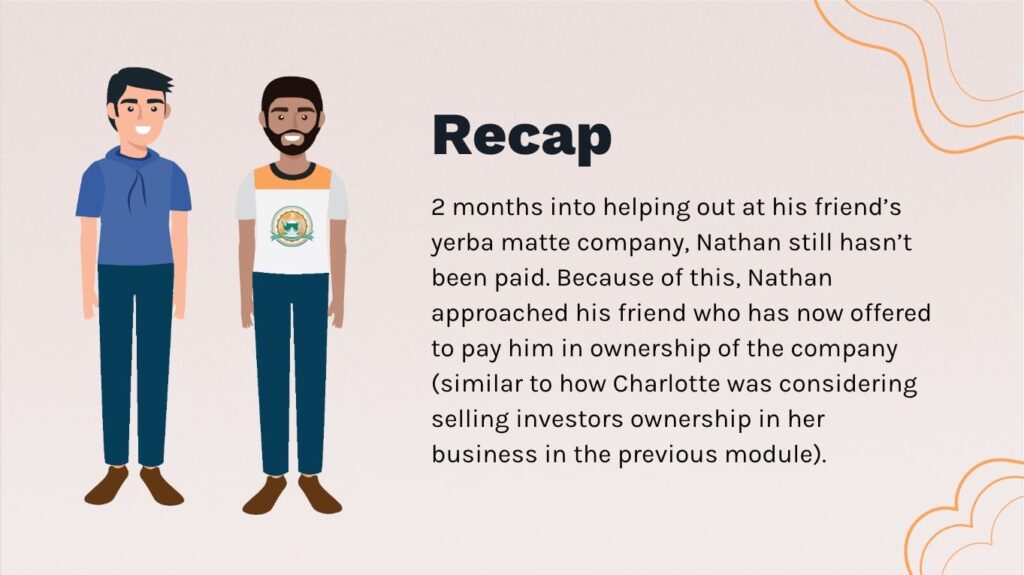
In the first half of each module, students were introduced to the challenges faced by the main character(s) for the week’s stories. Chosen for their relatability to everyday individuals and business owners, the introduction of each story served as an opportunity for the students to see their own experience in that of the main characters. Once they saw the main characters’ challenge as something they could relate to, they were able to see the entire lesson plan for that week in a different way.
Rather than seeing the content as something they had to engage with in order to pass the class, the assigned learning resources became resources that would equip them to overcome a financial obstacle they’ve encountered or anticipate encountering.
Stories as Practice Opportunities
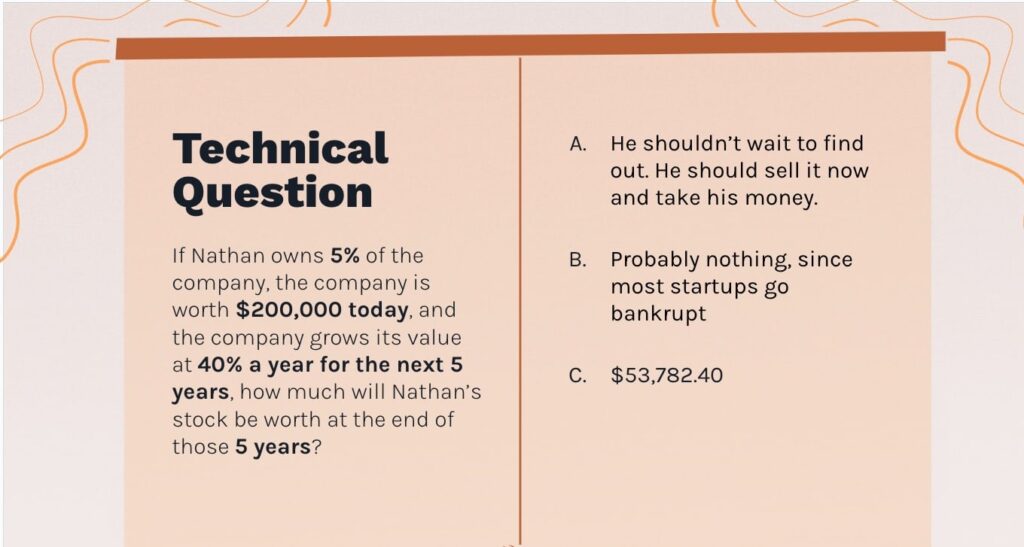
At the end of the module, the students were given the chance to offer a solution to the main characters’ problems using the technical tools introduced through the learning resources. Rather than the typical experience of completing optional practice problems, students had an opportunity to solve a personally meaningful challenge as a stepping stone to solving more complex problems in the assigned problem set.
For the purposes of standardization across the course, we formalized this loose process into the following steps:
1. Feel out The Situation
Students responded to introductory discussion questions based on the week’s stories, relying only on their intuitions.
2. Get Equipped
Students “got equipped” with the conceptual and technical understandings they need to understand the course content by completing readings and watching Drew’s lecture videos.
3. Navigate the Situation
Peer Learning
After engaging with the week’s learning resources, students applied what they learned to solve the conceptual and technical challenges faced by the characters at the beginning of the module, posting their solutions and justification in a group discussion.
Meanwhile, Drew met with rotating student group leaders to review their classmates’ answers and develop instructor-approved solutions. These leaders then shared the solutions with their peers and offered feedback on their work
Expert Modeling
Lastly, students review Drew’s own solution for the problems, getting a clear picture of his thought process at every step of the way.
4. Apply
Finally, students extend what they learned from the work they completed in the previous step by completing the week’s problem set.
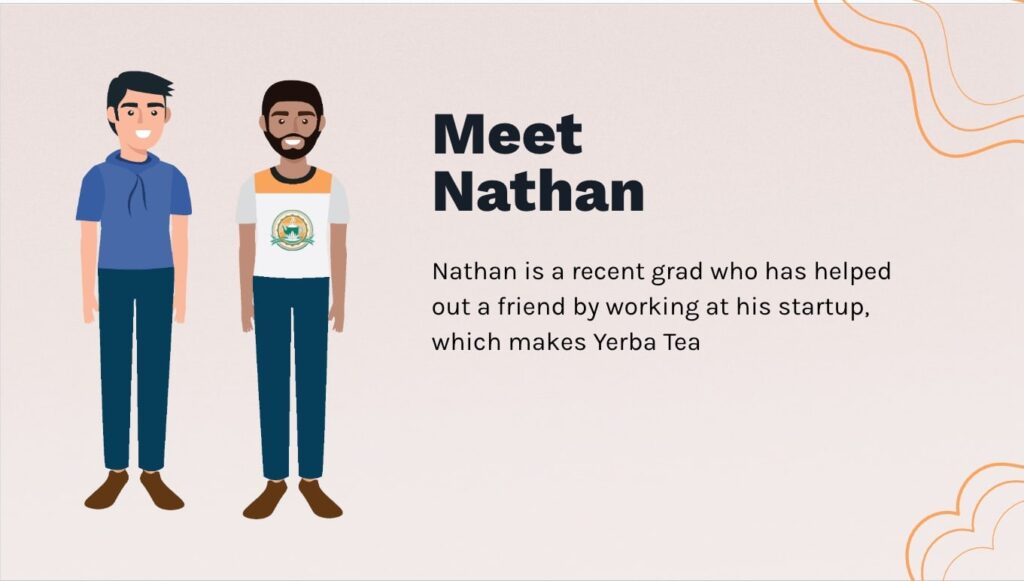
Drew ultimately wrote 18 original stories. Each week of the course featured two stories, one about an individual and one about a business, that grounded course concepts in real-world narratives. The screenshots below show how each of these stories was brought to life in slides used across the stages of the above framework.
Drew’s Evolution as a Teacher
Over the course of this project, Drew and I had many conversations about education and his own experience as a learner. Towards the end of our project, he recalled how, as a child, his dad would gather the kids around the kitchen table, set up a chalkboard, and keep them working through a tricky problem with only guiding questions until they found a solution.
That experience stands in stark contrast to school, where many of us were taught fixed formulas for fixed problems. While Drew’s weekends with his family strengthened his ability to design solutions to messy problems, his students’ time in traditional classrooms may have left that capacity underdeveloped in comparison.
This helps explain why Drew has always felt torn as a teacher. He’s a pro when it comes to learning new things, having learned his way into fields as diverse as espionage, Japanese woodworking, and most recently, Finance. For him, it’s natural to leverage his curiosity and passion for critical thinking to master challenging topics. That’s why meeting student requests for more materials or different explanations—like we set out to create in this project—has often felt at odds with what he wants for them.
But now he sees that the way he learns isn’t entirely innate—it was cultivated by experiences that others don’t necessarily share. This realization ultimately flipped a switch for Drew: he can’t assume his students arrive with the same motivation or habits of mind that he has. His job is to use teaching strategies that spark their curiosity and give them tools to face complexity with confidence.
Real Stories, Real Learning
Introducing story-based learning into Drew’s course allowed him to meet students where they were, while still upholding the high standards he values. Through our collaboration, Drew pulled from his own life to make abstract financial concepts “real” for students. The result was a course that not only helped students “get it” but also reflected the spirit of lifelong learning that defines Drew as an educator and person.
Example Stories
To view examples of the story slides, see the slide decks below.